Tag: State Expenditures

  • States’ Environmental Investments Continue to Grow: State Economic Development Expenditures Database Update

    Written by Jacob Stenstrom

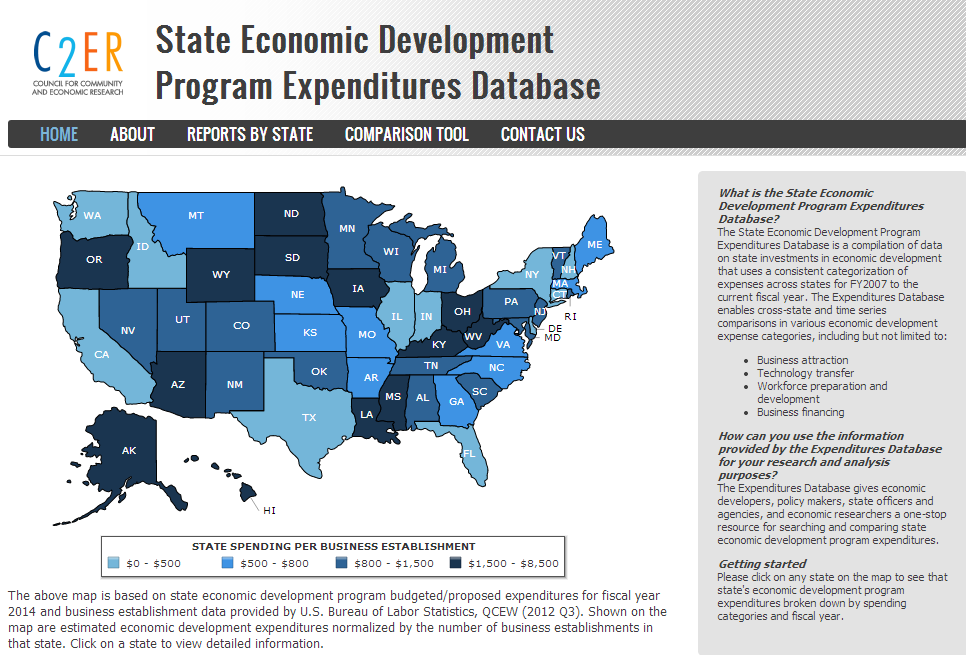
    The State Economic Development Expenditures Database blog series begins today and marks the release of the updated database. Over the next several weeks, the Council for Community and Economic Research (C2ER) will be releasing blogs that highlight important findings from the latest update. The database serves as the premier tool for researchers to easily access, explore, and analyze economic development spending at the state level with the data directly hand extracted from each state’s governor’s recommended budget. The database is updated on an annual basis and is available here to all subscribers and C2ER members.

    With the passage of the Inflation Reduction Act (IRA) at the close end of one of the hottest summers on record, particular focus is being paid to environmental sustainability efforts across the country. As the green sector of America’s economy continues to grow, states have increased investment into environmentally focused economic development. Starting in 2016 with the signing of the Paris Climate accords, total spending has risen from $48 million in funding to a peak of $475 million in 2022. That almost 10-fold increase in spending was originally spurred by funds outside General Fund and Federal Assistance. Only in more recent years are states starting to shift and dedicate more General Fund spending to green initiatives as states begin to rely less on other funding sources. In calculating state investment on environmental economic development, CREC analyzed state level spending on direct investment to green businesses, workforce support and retraining for jobs in the green economy, and support for industrial revitalization. These economic development programs are almost always focused on firms or employers.

    Overall economic development spending has increased since 2016, however the share spent on environmental economic development has also increased. While increases in environmental development spending were slow to take off directly after the signing of the Paris climate accords, more recent data shows that states are more willing to support and invest in their own green economy. As shown in Figures 2, the largest jump in environmental spending was between 2019 and 2020 when the share of total economic development spending increased by nearly 0.5%. The jump reflects an increased vigor at the state level to invest in environmental programs, even in the absence of major increases in federal funds to assist.

    The five states that spent the most on environmental economic development were Kansas, Hawaii, Pennsylvania, New Jersey, and Ohio. Of these, Ohio had the largest increase in investment between FY2021 and FY2023 while Kansas had the largest overall investment, despite a slight dip in investment in recent years. Environmental economic development spending is concentrated into just a few types of programs in these top five states. The largest spenders, Kansas and Hawaii, have concentrated spending into single large programs that cover a wide variety of objectives, while the other three states primarily invest in environmental cleanup. This includes hazardous waste, industrial site preparation, and brownfield programs that aim to revitalize previously harmed land to be retooled to serve both the economic development and environmental interest of the state.

    Kansas’ budgetary expenditure on environmental economic development can be found it its Division of Environment, which is housed under the state’s Department of Health and Environment. The program handles traditional environmental cleaning and upkeep as well as green industry permitting, research and development assistance, and a focus on providing funding to support the local water supply. While there is currently a 12% funding decrease planned between FY2022 and FY2023, the main driver of that decrease is a decline in federal assistance. Despite this reduction of federal help, the state still shows strong support for the program by committing to more state level investment. The governor of Kansas has proposed a roughly 1500% funding increase to the program from the general fund bringing the general fund expenditure on the division from $4 million to $69 million. The shift to a reliance on state level funds over time reflects the general trend.

    Hawaii’s Green Infrastructure Authority is the primary green economic development program. The program, constituted in 2014, vastly increased in state funding support between FY2018 and FY2020. The objective as stated by the authority is to use these funds to help expand the clean energy through market driven approaches with the goal of 100% renewable portfolio standard in the electricity sector by 2045. Products and services offered by the Authority include direct loans for eligible energy improvements to homeowners, small businesses and project sponsors, and the Green Energy Money $aver On-Bill Program which provides financing for green energy projects to be paid back through the ratepayer’s utility bill. While not having marked additional money for the program in the state’s latest budget, the state has held constant its funding at $86 million. Even without additional funding, the program itself has been financially successful for the state’s goals. As of December 2019, the state had exceeded its original financing goal by almost double, for a total of $49 million in financing.

    For more information and updates, visit the C2ER State Economic Development Program Expenditures Database.

  • 2017 C2ER Accomplishments

    During the past 12 months, the Council for Community and Economic Research, YOUR professional membership organization, has been hard at work increasing the visibility of economic, workforce, and community research by advocating for higher quality data, promoting more focused public and private investments in local data, and continuing to strengthen C2ER products and services.  We keep you informed about new data sources, exciting research, and opportunities to learn.  Following are some of the most vital accomplishments during the past year.

    Communication with Data Users and Producers

    Publications: C2ER/LMI Institute Weekly Update and Journal

    • Modernized the weekly Update with a fresh look
    • Monitored and summarized emerging data issues, relevant events, and recent research
    • Distributed weekly Update to more than 8,000 individuals, including members and targeted stakeholders
    • Developed target updates to non-members to increase membership rates among current readers
    • Published blog posts on topics relevant to C2ER members, including C2ER events and economic development news and trend analysis (https://blog.c2er.org/)
    • Produced four specialized blog-formatted articles for the Journal of Applied Research in Economic Development on relevant issues to economic development analysts and practitioners

    Annual Conference, Training and Certification

    • Coordinated C2ER Annual Conference, LMI Institute Annual Forum and the Projections Managing Partnership (PMP) Summit for more than 240 attendees
    • Delivered in-person training courses:

    Basic Labor Market Information Analyst

    Foundations of Applied Economic Development Research

    Intermediate Tableau for Economic and Workforce Developers

    Leadership in Research Workshop

    Analyzing & Developing Workforce Studies

    New Census Tools 101

    Applied Analyst Training

    • Conducted 24 webinars, reaching over 2,000 audience members
    • Certified three new Certified Community Researchers (CCR) in Quarter 4, 2017

    Data Advocacy and National Visibility for C2ER Member Efforts

    • Served as member of BLS Data Users Advisory Committee
    • Collaborated with Friends of BLS and the Census Project in federal statistical advocacy efforts
    • Met periodically with key Census, BLS, and BEA leaders to improve regional data access
    • Represented the interests of statistical data users in meetings with Congressional staff during several visits to Capitol Hill, including organizing C2ER volunteers to contact Congress
    • Signed on to several letters advocating for proper funding for Census, BLS, and BEA
    • Provided input and technical assistance to the Commission on Evidence-Based Policymaking

    Data Collection and Research Activities

    Cost of Living Index – C2ER’s flagship data product since 1968   http://www.coli.org

    • Remodeled and issued 2017 County and State Level Cost of Living Index
    • Improved the process of library application and added three non-COLI databases including the State Business Incentives Database, State Economic Development Program Expenditures Database, and C2ER Diversity Index Database
    • Conducted online data scraping for housing, grocery, and miscellaneous categories nationwide
    • Attended annual conferences for the American Library Association, Tableau, and Emsi to promote C2ER products and membership
    • Increased metro participation with eight new communities contributing data

    C2ER State Business Incentives Database Update http://www.stateincentives.org/

    • Maintained and updated unique summary of around 1,800 state programs designed to help businesses create jobs with 2017-2018 state legislative changes
    • Added additional programs for all U.S. states, territories, and the District of Columbia
    • Renewed the partnership with SelectUSA at the U.S. Department of Commerce to provide content to international companies seeking U.S. facility locations
    • Updated the program manager contact list based on state agency feedback

    C2ER State Economic Development Program Expenditures Database Update  http://www.stateexpenditures.org

    • Updated database for FY 2018 proposed expenditures, as well as FY 2016 actual and FY 2017 appropriated expenditures (when available), for all 50 states in the database
      • Updated 2,300 and added 1,100 more state economic development program expenditure records

    Other Policy and Economic Research and Technical Assistance

    • Continued partnership on a two-year project on state data sharing laws, regulations and agreements for a project sponsored by Laura and John Arnold Foundation
    • Assisted National Association of State Workforce Agencies (NASWA) with assessing the data analytic opportunities from the National Labor Exchange database of job openings data
    • Provided state incentives information to the U.S. Dept. of Commerce SelectUSA program
    • Conducted research on Current Population Survey microdata about the prevalence of credentials by education level, occupation, and other workforce characteristics
    • Launched the C2ER Tools of the Trade Database, an online resource for economic and workforce developers to identify data resources to guide their research
  • Illinois’s State Budget Impasse

    Passing the annual budget is often a difficult task for state governments, particularly during lean fiscal periods. Over the past few months, Illinois has found resourceful ways to avoid a complete government shutdown after not passing their annual state budget.

    The state is making its way through the second month of the fiscal year without a budget. Previously created laws and court decisions require funding to continue for about 80% of state spending, including paying state employees and Medicaid bills. However, many of Illinois’s economic incentive programs have been suspended as the state deals with no full year plan for spending.

    Governor Rauner wanted a substantially reduced budget compared to what was passed by the General Assembly in June. The General Assembly’s proposed budget had revenue increases to fix the state’s current deficit, which Governor Rauner was open to if changes were made to workers’ compensation, civil lawsuit damage award limits, and public union bargaining and contracting rules, as well as a freeze on property taxes. Two months later, neither side seems much closer to an agreement. A small sign of progress occurred August 12 when the State House agreed unanimously to free $5.2 billion in federal funding that had been unavailable since July 1st because no budget has been passed.

    While the federal funding will help, 20 percent of recently surveyed state social service providers will run out of money in the next few weeks. Along with economic development programs, state universities are also part of the list of organizations not getting funding. ReBoot Illinois has created a continually updating map of people and organizations that have been impacted by the budget impasse.

    Newly-elected Governor Bruce Rauner has wrestled with how best to handle state business incentive programs. In April, the Rauner administration lifted the spending freeze it placed upon $100 million in business tax incentives for the state’s Economic Development for a Growing Economy (EDGE) program. The EDGE program provides tax credits to corporations to encourage the businesses to expand their operations in Illinois. To help reduce the state’s current deficit of $4 billion, at the start of June Governor Rauner suspended the application process for any future economic incentives used to attract and grow businesses. These programs have yet to be reactivated.

    Illinois’s unusual situation is risky for the state’s economic future if funding for key state economic growth programs continues to stay low. The state’s credit rating will likely be downgraded soon and Illinois was recently ranked last in financial health by the Mercatus Center at George Mason University. Although no end appears to be in sight, Illinois will eventually have to pass a budget or else face running out of money completely. Until then, the future of Illinois’s business incentive and other economic development programs remains uncertain.

  • State Economic Development Program Expenditures: FY2014-FY2016 Update

    State Economic Development Program Expenditures: FY2014-FY2016 Update

    The Council for Community and Economic Research (C2ER) has updated its State Economic Development Program Expenditures Database as part of a continuous effort to track investments in economic development across all fifty states. The database now includes all Governor Recommended Budgets for fiscal year 2016. Read the full report on this update here.

    Expenditures14

    According to the Database, in FY2016 U.S. states are collectively proposing to spend $6.97 billion on economic development investments, representing a slight dip from FY2015 spending levels. In FY2015, states appropriated $7.05 billion for economic development, which was a 7 percent increase over actual economic development spending of $6.65 billion in FY14. (more…)

  • Annual Versus Biennial Budgeting

    Users of the C2ER Economic Development Program Expenditures Database may notice differences in how frequently the budget for each state is released. This is because states have the choice of using either annual or biennial budgets, meaning budgets released every two years. Therefore, some states will not release their proposed budget for an extra year, or will not release actual budget numbers for more than two years. A number of factors go into why a state decides to use an annual or biennial budget. (more…)

  • States propose funding apprenticeships

    apprenticeship picAs data from the proposed FY2016 State Budgets are released, C2ER has been updating the C2ER State Economic Development Program Expenditures Database. As C2ER staff review the state budgets that have been released over the past few months, they have been looking for investments in apprenticeship programs.

    Here are highlights from Connecticut, Iowa, and Maryland:

    • Connecticut’s proposed FY2016 apprenticeship funding is fairly consistent with FY2015 and FY2014, proposing approximately $575,000 in general fund expenses for the program.
    • Iowa proposed a 9% funding increase for FY2016 for the Iowa Apprentice Program, which is administered by the Iowa Economic Development Authority in coordination with the Office of Apprenticeship at the US Department of Labor. The program was created with the Iowa Apprenticeship Act in 2014.
    • Maryland significantly increased funding from FY2014 to FY2015, with a 60% in state funding allocated to the apprenticeship program. FY2016 included a proposed estimated 6% increase in state funding.

    For more information and updates, visit the C2ER State Economic Development Program Expenditures Database. Please note that updates will not appear to users until all FY2016 state updates are complete in June 2015.

  • FY 2016 Proposed State ED Budget Cuts

    As data from the proposed FY2016 State Budgets are released, C2ER has been updating the C2ER State Economic Development Program Expenditures Database.  The proposed budgets provide information on eliminated programs and decreased funding for economic development financing, with many affecting small business development related programs.

    (more…)

  • State Initiatives in International Markets

    State Initiatives in International Markets

    According to the C2ER State Economic Development Expenditure Database, international trade and investment is among the fastest growing economic development functional areas. C2ER defines the international trade and investment function as program activities  involving export promotion, international marketing and recruitment, foreign direct investment assistance, and an array of programs aimed at building stronger economic ties between states and other parts of the world.

    Int1Since 2012, states have increased their program expenditures in international trade and investment from $61 million in FY 2013 to $75 million in combined proposed spending for FY 2015 – a 23 percent increase. This rise in investment can possibly be connected with the successes of the Small Business Administration’s State Trade Export Promotion (STEP) Grant Initiative, a 3 year pilot program which uses matching-fund grants to assist eligible employers in becoming engaged in the international marketplace. Essentially, the grant subsidizes the marketing costs states accrue in advertising their businesses’ goods and services internationally. (more…)

  • Funding Highlights From Proposed FY2016 State Budgets

    Funding Highlights From Proposed FY2016 State Budgets

    C2ER staffers are busy digging through the newest proposed state budgets for FY2016. As we update the State Economic Development Program Expenditures Database, a number of programs have stood out. The proposed budgets include new programs as well as some major funding increases in economic development financing, infrastructure and construction, research and development, and employment training. (more…)

  • GASB State Tax Incentive Rule

    GASB Tax Incentive Picture Beginning in 2017, those interested in incentives and tax abatement expenditures spending will likely have access to significantly more data than is currently available. The Governmental Accounting Standards Board (GASB), the independent organization which “establishes financial accounting and reporting standards for state and local governments,” is asking for public comments on a proposed change to current standards for property and tax abatement agreements. (more…)